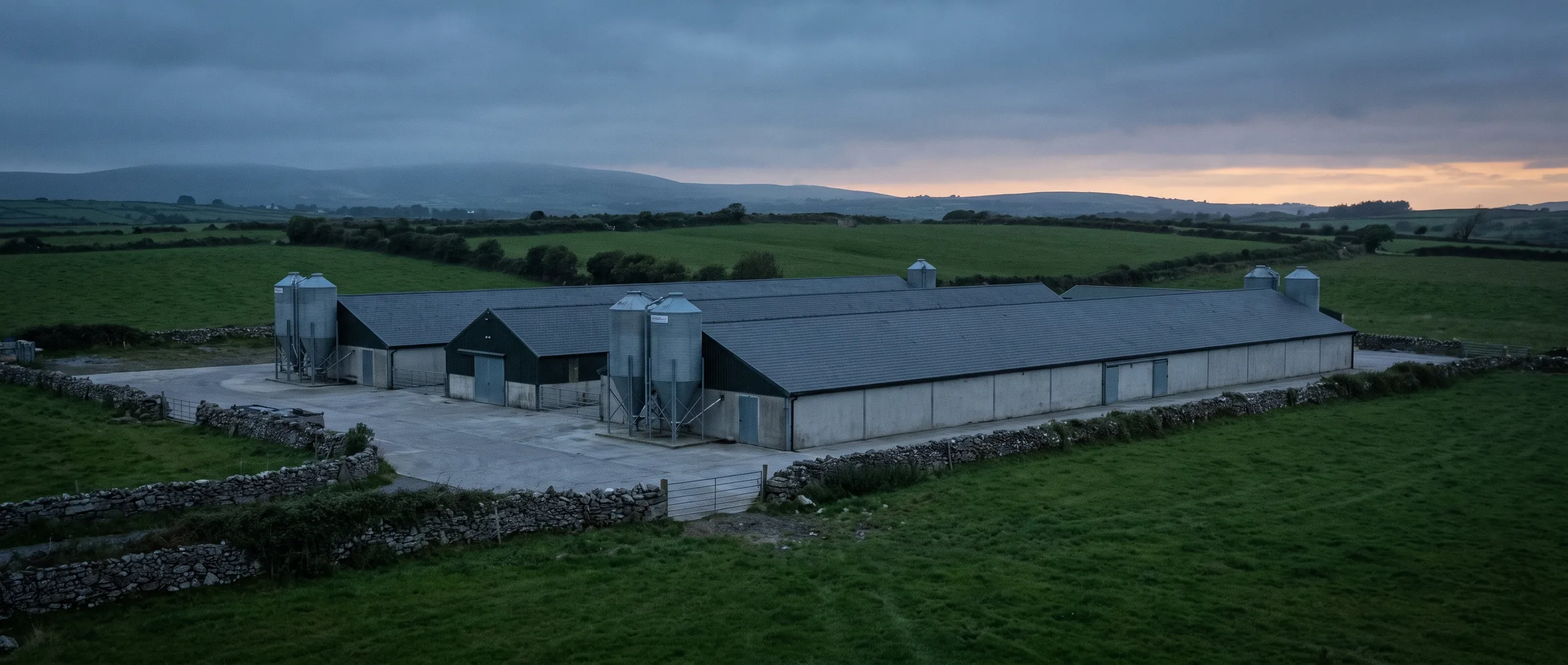
Integrated pig production, Spancill Hill, Co. Clare
You could walk through it in your good clothes.
A 760-sow integrated pig unit at Spancill Hill, Co. Clare. Breeding, rearing and finishing on one site since 2006.
2006
Trading since
760
Sows on site
One site
Breeding, rearing, finishing
Bord Bia
Quality assured herd
A modern unit, rebuilt from the ground up.
Kilfilum has been a working piggery since 2006. The unit at Spancill Hill has grown and been rebuilt over the years since, and today almost every part of the day's work runs through computerised systems: feeding, climate, records, and the alarms that watch the buildings when nobody is standing in them.
That matters for one reason. An integrated unit breeds, rears and finishes its pigs on the same farm, so nothing is brought in and nothing is moved between sites. Disease is easier to keep out, the pigs never carry travel stress, and the management stays tight.

One farm, three stages, no gaps in between.
Breeding, rearing and finishing happen inside the same operation. The pig that leaves us for the factory has been under the same care from the day it was born.
Farrowing
Sows farrow in pens on site, with litters arriving through the year. Piglets stay with the sow until weaning, in a dry, warm lying area.
Weaning
After weaning, pigs go into stable groups and are mixed as little as possible. Calmer pigs eat better, grow better and need fewer interventions.
Finishing
Grown on to sale weight on a ration we mill ourselves, then finished through our own site in County Kerry and sent to factories here and in the North.

Animal welfare
Welfare is a system, not a slogan.
Group housing, room to lie down together, eight continuous hours of light a day, and standby power that is tested and recorded every month. The legislation sets the floor. The daily routine goes past it.
We mill our own feed.
Meal is bought in from several suppliers, then ground and mixed here on the farm. That way we know exactly what is going into the ration, and we take the middle man out of the cost.
Feed is the single biggest cost in growing a pig, so it is the one we watch hardest: how much goes in, how efficiently it converts, and what we paid per tonne.

Bought in
Sourcing
Cereal meal comes from a number of suppliers, so there is no single point of failure.
On site
Milling
Ground and mixed at the unit, which keeps the formulation under our own control.
Herd-wide
Performance review
Intake and feed conversion are judged across the herd, not by eye in one pen.
To appetite
Feeding
Feed is kept readily available, which lifts intake and makes the ration work harder.
Irish herd benchmarks
The standard the national herd is measured against.
Pig production is the third most important sector in Irish agriculture after beef and dairy, and it exports the great majority of what it produces. These are the figures Teagasc records across the country each year.
15.43
Pigs born alive per litter
Up from 14.94 in 2023
2.36
Feed conversion, weaning to sale
Kilos of feed per kilo of gain
28.4
Pigs produced per sow per year
Average of recorded herds
2,593 kg
Pig meat per sow per year
Up 6.8% since 2020
Source: Teagasc National Pig Herd Performance Report 2025, covering 85 recorded herds and more than 74,500 sows, roughly 55% of the national sow herd. These are sector averages published by Teagasc, not Kilfilum's own performance figures.
From the farm
The unit, the pigs and the people.
Not stock photography. Every photograph below was taken at Spancill Hill: the yard and the gate, the houses during a daily check, and the crew that runs the place.


On the Spancill Hill road
Kilfilum sits behind its own stone pillars outside Ennis, with the houses, the yard and the feed mill all on the one site. Have a look around the unit, or get in touch about supply.

The industry's real shortage is people.
Irish pig production supports more than 8,000 jobs across farms, processing, feed, haulage and services, and the number of people coming into the sector keeps falling. The work is computerised, the pay is competitive, and the animals are worth caring about properly. If you want a trade that runs on data and stockmanship, this is the place to learn it.